Friday, August 21, 2026

NEW EVIDENCE: Charlie Kirk Was Killed By A Military Drone! w/ John Cullen

Watch "NEW EVIDENCE: Charlie Kirk Was Killed By A Military Drone! w/ John Cullen" on YouTube
https://youtu.be/Zsy6D9pTi-U?is=UUyGpanVZ0WPxxtn 

The VHS Universe: What If Reality Is Already Recorded, but We Still Get to Choose?

The VHS Universe: What If Reality Is Already Recorded, but We Still Get to Choose?

By JM Talboo 

I've been thinking about a strange possibility.

What if reality is more like a collection of recordings than a single movie?

Not necessarily a literal VHS tape.

I'm using the VHS analogy because it's something almost everybody understands.

Imagine that your entire life is recorded on a tape.

The tape contains everything that happened.

Every conversation.

Every decision.

Every mistake.

Every relationship.

Every fork in the road.

Everything.

Now imagine that you could rewind the tape.

You could watch the same life again.

But this time, you could choose differently.

That immediately creates a fascinating problem.

If the original recording already exists, does that mean your choices weren't real?

Or could both things somehow be true?

Could the events already exist from some larger perspective while the person experiencing them still genuinely experiences choice?

I think that's where things get much more interesting than the simple argument over whether the universe is deterministic.

The Universe Doesn't Necessarily Have to Be a Straight Line

We tend to imagine time as a line.

Yesterday leads to today.

Today leads to tomorrow.

One thing happens, then another thing happens, then another.

But that's not the only way philosophers have modeled time.

There is an actual philosophical concept called branching time.

In branching-time models, histories can share a common past and then diverge into different possible futures. A useful way to visualize it is as a tree: the trunk represents the shared history, while the branches represent different possible developments. This isn't a claim that physicists have demonstrated that our universe literally works this way. It is a formal philosophical framework for thinking about alternative possible futures.

Stanford Encyclopedia of Philosophy — Branching Time:

https://plato.stanford.edu/archives/spr2026/entries/branching-time/

That's remarkably close to the metaphor I've been using.

Imagine that reality isn't a single line.

Imagine it's spaghetti.

There are countless strands.

Some strands remain close together.

Some separate dramatically.

Some might eventually reconnect.

Some might represent possibilities that were never actually experienced.

And perhaps, from the perspective of the person standing inside one strand, it feels exactly like ordinary life.

You make a decision.

You don't know what would have happened if you'd made the other choice.

You move forward.

That's your reality.

But perhaps the other possibilities aren't meaningless.

Perhaps they're simply other branches.

The Flash and the Spaghetti Universe

One of the funniest places I've seen a similar concept presented is in the 2023 movie The Flash.

Michael Keaton's Batman attempts to explain the strange consequences of Barry Allen's manipulation of time by comparing the universe to spaghetti.

The basic visual idea is that history isn't necessarily a neat straight line. Events can become tangled, displaced and connected in strange ways.

It's fiction, obviously.

But fiction is useful for this kind of discussion because it gives us visual metaphors for ideas that are otherwise extremely difficult to communicate.

The Flash's spaghetti analogy isn't scientific evidence for branching universes.

It's an illustration.

And that's exactly how I want to use it.

The question isn't:

“Did Batman prove that the universe is spaghetti?”

Obviously not.

The question is:

“Is spaghetti a useful metaphor for a universe in which time, causality and possibility aren't as simple as we normally imagine?”

I think it is.

The VHS Version

Now take the spaghetti and combine it with the VHS.

Imagine that every completed branch is a recording.

You are currently watching one.

You experience it sequentially because that's how consciousness operates from your particular perspective.

But somewhere outside that perspective, the entire recording exists.

Now imagine there are other tapes.

Tape A:

You took the job.

Tape B:

You didn't take the job.

Tape C:

You took it and met someone who changed your life.

Tape D:

You rejected the opportunity.

Tape E:

You took an entirely different path and never met that person at all.

From inside Tape A, you don't experience Tapes B, C, D and E.

You experience choice.

That's important.

The existence of a recording doesn't necessarily tell us anything about what it felt like to make the decision while the recording was being created.

If you watched the finished tape, you could say:

“Of course he was going to make that decision.”

But the person experiencing that moment didn't have the luxury of knowing the ending.

He had to decide.

That distinction is the heart of the thought experiment.

The Strange Possibility: A Fixed Sequence Can Still Contain Real Choices

This is where the whole thing gets weird.

Suppose an observer outside time could see your entire life at once.

From that perspective, your choices might appear completely determined.

But from inside your life, you still deliberate.

You consider possibilities.

You feel uncertainty.

You choose.

You experience consequences.

You learn.

Those two perspectives don't necessarily have to contradict each other.

This is one reason philosophical discussions of time and free will become so complicated.

Eternalism, for example, is the view that past, present and future events exist in some sense, rather than only the present existing. Presentism takes the opposite position, holding that only the present exists. These are philosophical positions about the ontology of time, not established experimental discoveries about which model is correct.

Stanford Encyclopedia of Philosophy — Time:

https://plato.stanford.edu/entries/time/

Stanford Encyclopedia of Philosophy — Presentism:

https://plato.stanford.edu/entries/presentism/

And branching-time philosophy adds another possibility: instead of there being one already-determined future, there could be multiple possible histories branching from a shared past.

So we don't necessarily have only two choices:

Everything is predetermined.

or

Nothing is predetermined.

There may be much stranger possibilities in between.

Terminator 2: No Fate

This is where Terminator 2: Judgment Day gives us one side of the argument.

The movie famously presents the idea that the future isn't simply fixed and that people can make different choices.

That's a powerful idea.

If Sarah Connor can change the future, then the future isn't necessarily a single VHS tape that has already been recorded.

Maybe it's a blank tape.

Maybe we're recording it as we go.

Maybe our choices actually create the future.

That's one possibility.

But then Terminator 3: Rise of the Machines comes along and essentially asks:

What if some things are harder to change than you thought?

The movie's central reversal is that Judgment Day wasn't prevented; it was postponed. The Terminator tells John Connor that Judgment Day is inevitable, and the ending explicitly leaves John confronting the possibility that the future may have been written after all.

Terminator 2:

https://www.imdb.com/title/tt0103064/quotes?item=qt0416784

Terminator 3:

https://www.imdb.com/title/tt0181852/quotes?item=qt0315919

That creates a fascinating philosophical tension.

Maybe Terminator 2 is saying:

Your choices matter.

And Terminator 3 is saying:

Yes—but perhaps your choices occur inside a larger structure that you don't completely control.

Those aren't necessarily mutually exclusive.

Maybe you can choose the route without choosing the destination.

Maybe you can choose the destination but not the circumstances.

Maybe there are certain events that are effectively fixed while everything surrounding them remains flexible.

Or maybe there are multiple timelines in which different choices are made, while each individual timeline remains internally consistent.

Thanos: “I Am Inevitable”

Marvel gives us another version.

Thanos doesn't simply say that he wants something.

He declares inevitability.

“I am inevitable.”

The interesting thing isn't whether Thanos is actually correct.

He's not.

The interesting thing is the concept.

A character can experience himself as making choices while simultaneously believing that the outcome is inevitable.

That is exactly the philosophical problem we're playing with here.

What if inevitability exists at one level while choice exists at another?

Groundhog Day: The Replay

Then there's Groundhog Day.

This one may actually be the most useful metaphor of all.

Phil Connors wakes up every morning to the same day.

He remembers.

Everyone else doesn't.

The same events keep happening, but Phil's knowledge changes.

And because his knowledge changes, his choices change.

Eventually, the repetition transforms him.

That's a very different concept from simply saying:

“The universe is deterministic.”

Phil isn't merely watching a recording.

He's learning from it.

He's experimenting.

He's discovering what happens when he changes something.

And eventually, he becomes a different person.

The movie establishes the repeating structure through Phil repeatedly waking on February 2 to the same morning broadcast and Sonny & Cher's “I Got You Babe.”

Groundhog Day screenplay:

https://imsdb.com/scripts/Groundhog-Day.html

Imagine applying that concept to an entire lifetime.

What if consciousness could live a life again?

What if it could remember the first run?

What if it could try again?

What if every version of the life remained real from its own perspective?

Suddenly, “What if I had made a different choice?” becomes a much bigger question.

Maybe you don't have to wonder.

Maybe you could actually find out.

Choose Your Own Adventure

When I was younger, Choose Your Own Adventure books gave us a primitive version of this concept.

You read a few pages.

Then the book tells you to make a choice.

Go to page 42.

Or go to page 87.

You pick one.

That becomes your story.

But page 87 didn't cease to exist simply because you picked page 42.

The alternative remained there.

You just didn't experience it.

Now imagine that the universe worked something like that.

You reach a fork.

You choose.

Your experience continues down one path.

But another possibility exists.

Maybe it exists only as a mathematical possibility.

Maybe it exists as an unrealized counterfactual.

Maybe it exists in another universe.

Maybe it exists in some deeper metaphysical structure.

Maybe it doesn't exist at all.

We don't know.

But the metaphor gives us a way to think about the distinction between what happens and what could have happened.

The Matrix: What Is the Player?

Then we get to The Matrix.

The Matrix adds another layer to the thought experiment.

What if the person you think you are isn't the entirety of what you are?

Neo initially believes he is an ordinary human being living an ordinary life.

Then he discovers that his apparent reality is an artificial environment.

The important revelation isn't simply:

“This world isn't real.”

It's:

“I am more than I thought I was.”

That distinction is central to the spiritual version of this thought experiment.

Maybe the body is the avatar.

Maybe consciousness is the player.

Maybe ordinary reality is the environment.

Maybe death is logging out.

Maybe reincarnation is logging back in.

Maybe none of those things are true.

But once you allow the possibility, an entirely different set of questions becomes available.

The Matrix isn't evidence that we live in a simulation.

It's a modern myth about awakening.

And that's why it connects so naturally with ancient traditions that also talk about ignorance, illusion, awakening, the true nature of the self, and liberation.

An annotated exploration of those connections I reposted:

https://debunkingdeath.blogspot.com/2015/10/gnosticism-and-buddhism-in-matrix.html

The Spiritual Version

Now let's take the thought experiment one step further.

Suppose consciousness is fundamental.

Suppose the individual consciousness is somehow an expression of a greater consciousness.

Call it the One.

Call it God.

Call it Buddha-nature.

Call it universal consciousness.

Call it whatever you want.

The name isn't the important part.

The important question is:

Why would the One experience limitation?

If unlimited consciousness already knows everything, what would it be like to experience not knowing?

If it has no limitations, what would it be like to experience limitation?

If it is eternal, what would it be like to experience a finite life?

If it knows every possible outcome, what would it be like to experience uncertainty?

Maybe that's the point.

Maybe limitation isn't a defect in the system.

Maybe limitation is the experience.

You can't experience surprise if you already know everything.

You can't experience discovery if you remember the answer.

You can't experience courage if you already know you are completely safe.

You can't experience forgiveness if nobody can hurt you.

You can't experience growth if nothing challenges you.

You can't experience choosing if you already remember every consequence.

And that brings us back to the VHS.

Maybe the Amnesia Is the Feature

What if forgetting isn't the bug?

What if it's the feature?

Imagine being an unlimited consciousness that voluntarily enters a limited perspective.

You forget the larger reality.

You forget the other lives.

You forget the ending.

You forget that the whole thing may already exist from another perspective.

And then you live.

You fall in love.

You lose people.

You make mistakes.

You make choices.

You wonder what the hell you're doing here.

You search for answers.

You find pieces.

You lose them again.

And eventually, perhaps, you remember.

That would make awakening something very different from merely escaping.

It would be remembering while still inside the experience.

The Non-Spiritual Version

Now strip all the spirituality away.

We don't need God.

We don't need reincarnation.

We don't need a soul.

We don't even need a simulation.

The thought experiment still works.

Computer science routinely uses branching structures to model possible future states.

Artificial intelligence systems explore possible actions.

Video games maintain states and allow different choices to produce different outcomes.

A simulation can contain a fixed set of rules while still allowing unpredictable outcomes from the perspective of the individual player.

And philosophy has spent centuries asking whether determinism is compatible with meaningful human agency.

So even if the entire spiritual framework turns out to be wrong, the underlying question remains legitimate:

Can a system be governed by rules without every meaningful description of choice becoming meaningless?

I think that's a much more interesting question than simply shouting “free will” or “determinism” at each other.

The Book of Life

Now here's where I take the VHS metaphor somewhere more speculative.

Suppose there really is some kind of ultimate record.

Call it the Book of Life.

Not necessarily a literal book.

Not necessarily a heavenly database.

Just a metaphor for the totality of what has happened.

Once an event has happened, it is part of history.

It's written.

You can't make yesterday unhappen.

But perhaps you could simulate it.

You could reconstruct it.

You could explore what would have happened if a different choice had been made.

And here's the really strange possibility:

Perhaps a simulation of an already-completed life could contain choices that were never part of the original life.

In other words:

The original event happened.

That history is fixed.

But you can create a model of it.

Then you can change the variables.

You can ask:

“What if?”

What if I had gone left?

What if I had stayed?

What if I had met that person earlier?

What if I had taken the other job?

What if I had made the decision differently?

The original history doesn't change.

But the simulation can explore alternatives.

That gives us a playground that potentially sits on top of almost every other possibility we've discussed.

The Simulation of the Simulation

This is where my VHS analogy gets really strange.

Imagine reality itself is some kind of simulation.

Then imagine that consciousness inside that simulation eventually develops the ability to simulate its own history.

Now you have:

Reality.

Then:

A simulation of reality.

Then:

A simulation of events that have already occurred inside that simulation.

And perhaps:

A simulation of alternative outcomes from those already-recorded events.

It's simulations all the way down.

At that point, the question “Which one is real?” becomes less useful.

The better question might be:

Which level am I currently experiencing?

And perhaps consciousness can move between levels.

Again, that's speculation.

But it's a fascinating thought experiment.

What About the Future?

The future makes everything harder.

A completed past can obviously be recorded.

A future event hasn't happened yet, at least from our ordinary perspective.

So perhaps you can replay the past perfectly but only simulate possible futures.

That would create an interesting distinction:

The past can be replayed.

The future can be projected.

And maybe that's why the future feels fundamentally different from the past.

Or perhaps the distinction is only a feature of our perspective.

If eternalism were correct, then the philosophical picture would be radically different because future events could be regarded as existing in some sense along with past and present events.

If branching time were correct, there could instead be multiple possible futures.

If presentism were correct, only the current moment would exist.

These are not settled questions.

They're competing ways of thinking about time.

And that's precisely why I find them useful as philosophical tools.

Maybe All of These Are True at Different Levels

Here's the possibility I keep coming back to.

Maybe the universe isn't one simple thing.

Maybe several descriptions can be simultaneously valid depending on the level you're talking about.

From inside the experience:

I choose.

From the perspective of the completed timeline:

I made that choice.

From the perspective of a branching structure:

Other choices were possible.

From the perspective of a simulation:

Those possibilities can be modeled.

From the perspective of an eternal record:

The entire sequence exists.

From the perspective of consciousness:

I am experiencing one particular path.

And from a spiritual perspective:

Perhaps I am something larger than the character experiencing the path.

That isn't a proof of any of these propositions.

It's a framework for asking better questions.

So Which VHS Are We Watching?

Maybe there is only one.

Maybe there are infinitely many.

Maybe every possible decision creates another branch.

Maybe only one branch actually exists and the others are merely possibilities.

Maybe the universe is deterministic but consciousness experiences the determination as choice.

Maybe free will operates at a deeper level than ordinary physical causation.

Maybe time itself isn't fundamental.

Maybe consciousness is.

Maybe none of that is true.

I don't know.

But I don't think we have to choose between intellectual curiosity and spiritual intuition.

We can use both.

That's what I mean when I talk about theology, comparative religion, philosophy, science and fiction as tools in a toolbox.

I'm not claiming that The Flash secretly proves a metaphysical theory.

I'm not claiming that The Matrix proves we're living in a computer.

I'm not claiming Groundhog Day proves reincarnation.

I'm saying that human beings have been using stories to imagine these possibilities for a very long time.

And sometimes fiction gives us a picture that allows us to ask a question that mathematics or theology alone makes difficult to visualize.

Maybe reality is a line.

Maybe it's a tree.

Maybe it's spaghetti.

Maybe it's a VHS tape.

Maybe it's all of those metaphors at once.

And maybe the strangest possibility isn't that we're trapped inside the recording.

Maybe it's that we chose the recording, forgot that we chose it, and are now watching ourselves make the choices for the first time.

And if that's true?

Then perhaps the most important thing isn't figuring out which VHS we're on.

Perhaps it's making this one worth watching.

Further Reading and Sources

Stanford Encyclopedia of Philosophy — “Branching Time”:

https://plato.stanford.edu/archives/spr2026/entries/branching-time/

Stanford Encyclopedia of Philosophy — “Time”:

https://plato.stanford.edu/entries/time/

Stanford Encyclopedia of Philosophy — “Presentism”:

https://plato.stanford.edu/entries/presentism/

Stanford Encyclopedia of Philosophy — “Temporal Logic”:

https://plato.stanford.edu/entries/logic-temporal/

The Flash (2023), Warner Bros. Pictures / DC Studios.

The Matrix (1999), Warner Bros. Pictures.

Groundhog Day (1993), Columbia Pictures.

Groundhog Day screenplay:

https://imsdb.com/scripts/Groundhog-Day.html

Terminator 2: Judgment Day (1991):

https://www.imdb.com/title/tt0103064/quotes?item=qt0416784

Terminator 3: Rise of the Machines (2003):

https://www.imdb.com/title/tt0181852/quotes?item=qt0315919

Debunking Death — “Gnosticism and Buddhism in The Matrix — Annotated Edition”:

https://debunkingdeath.blogspot.com/2015/10/gnosticism-and-buddhism-in-matrix.html

9/11: A Review of the Evidence, the Official Account, and the Questions That Remain

September 11: A Critical Examination of the Evidence

Introduction: Following the Evidence Wherever It Leads

First off, just because the evidence suggests that rogue elements of the US government and intelligence apparatus, as well as other international intelligence agencies, were involved, doesn't mean bin Laden and Al-Qaeda hijackers weren't involved. 

Now let's drive in to the deep end my friends and foes! 

The purpose of this article is not to present every 9/11 conspiracy claim as established fact. Nor is it to insist that every anomaly surrounding September 11 proves a particular alternative explanation.

The purpose is considerably simpler:

What happens when the major pieces of evidence are examined together rather than one at a time?

Twenty-five years after September 11, 2001, an enormous body of material exists concerning the attacks: the official chronology, air-defense response, intelligence warnings, insider trading allegations, hijacker identification, physical evidence from the World Trade Center, firefighter testimony, the destruction and handling of evidence, the collapse of Building 7, the investigation of explosives and thermitic materials, and the subsequent conduct of government agencies.

Some of these subjects have straightforward explanations. Some remain genuinely disputed. Some popular 9/11 claims have turned out to be weak or mistaken. Others have survived years of attempted debunking.

That distinction matters.

I am not interested in defending a theory simply because it is called a “9/11 Truth” theory. If evidence contradicts something I have previously believed, then that evidence matters. Likewise, if an alleged debunking does not actually answer the evidence it claims to refute, that matters too.

One of the most useful principles expressed in an article I published in 2008, Debunking Myths on Conspiracy Theories, was that alternative explanations should ultimately be arbitrated by evidence rather than assumptions about the motives or psychology of the people proposing them.

The article itself was written by anonymous academic researchers and published by me with their permission. I considered it important enough to preserve, particularly because the original site on which it appeared subsequently disappeared.


The article discusses, among other things, the tendency to dismiss an entire body of research because some individual claims are weak, the misuse of ad hominem arguments, the assumption that conspiracies are inherently implausible, and the importance of distinguishing individual claims from the larger evidentiary question.

That distinction is especially important with 9/11.

1. The First Question: What Kind of Evidence Are We Talking About?

There are several fundamentally different categories of 9/11 evidence.

There is physical evidence: the buildings, aircraft debris, steel, dust, residues, photographs and videos.

There is eyewitness evidence: firefighters, police officers, emergency workers, civilians, air-traffic controllers and others who experienced the attacks.

There is documentary evidence: government records, intelligence warnings, FAA records, NORAD records, financial transactions and investigative reports.

There is chronological evidence: when agencies knew something, when they were notified, what they did, and when they did it.

And there is behavioral evidence: what institutions and individuals did before, during and after the attacks.

These categories should not simply be lumped together.

A video of an apparent explosion is not equivalent to a laboratory analysis of dust. A discrepancy in a government timeline is not equivalent to proof of controlled demolition. An intelligence warning is not proof that somebody knew precisely what was going to happen.

But neither should these categories be artificially isolated.

The real question is whether apparently independent pieces of evidence converge.

2. NORAD, FAA and the Military Response

One of the most important areas requiring examination is the response to the hijacked aircraft.

The official chronology presents a remarkable sequence of events.

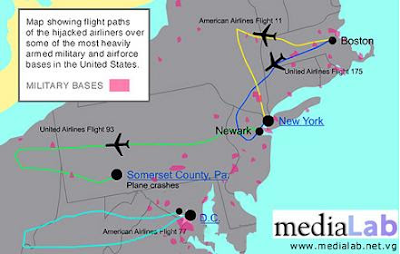
The 9/11 Commission's staff report states that at approximately 10:11 a.m., after news concerning a bomb aboard Flight 93 had spread through NEADS, personnel attempted to locate fighter assets. A Syracuse Air National Guard unit said it could launch fighters with loaded guns in approximately fifteen minutes.

The same chronology states that at 10:13 the Herndon Command Center advised FAA headquarters that it had concluded Flight 93 had crashed. At 10:15 NEADS contacted Washington Center regarding Flight 93 and was told that it had already crashed. 

The report further states that 10:31 a.m. was when NEADS received its first official rules of engagement authorizing military aircraft to shoot down tracks that did not respond to direction. The report also says that NEADS personnel were confused about the order and that it was not passed along to the pilots in the manner one might expect. 

This is important precisely because it does not establish that Flight 93 was shot down.

In fact, the official chronology says the opposite: Flight 93 crashed before the relevant authorization reached NEADS.

That is why I have never found the “Flight 93 was shot down” argument particularly compelling as an argument for an inside job.

If the aircraft was shot down, then someone had to actually intercept and destroy it. That would constitute an affirmative action requiring evidence.

If it was not shot down, however, the question becomes one of military response and possible institutional failure.

And that question does not become less interesting merely because the alternative theory is wrong.

Quite the opposite.

If the official chronology is substantially correct, then Flight 93 was hijacked, turned toward Washington, and ultimately crashed without being intercepted and destroyed by fighters.

That is an extraordinary failure requiring explanation.

And if alternative research concerning the chronology is correct in suggesting that some of the official times are themselves problematic, the question could become even more serious—not because a revised chronology proves an inside job, but because the longer the aircraft remained unmolested, the more difficult the response becomes to explain.

This is the point that can easily be lost in the “shot down/not shot down” debate.

The important question is not:
“Which theory helps 9/11 Truth?”

It is:

“What actually happened, and why?”
The 9/11 Commission's own documentation is therefore essential to the discussion.

John-Michael Talboo detailing his research into the many pre-9/11 warnings of terrorist attacks using planes as weapons.

At the following link I detail the UNBELIEVABLE LACK of response from NORAD and other facilities equipped to defend our air space on the morning of September 11, 2001.


3. Flight 93 and the “Shot Down” Question

There is another reason I think this issue deserves a more nuanced treatment.

Flight 93 crashed at extremely high speed. The final flight data and cockpit recording place the crash at approximately 10:03 a.m., with the aircraft descending rapidly during the final struggle in the cockpit. 

The fact that the aircraft broke apart extensively upon impact is therefore not, by itself, evidence that it was shot down.

Indeed, if an aircraft traveling hundreds of miles per hour impacts terrain at a steep angle, extensive fragmentation is exactly the sort of result one would expect.

The more interesting question is not what the wreckage looked like afterward.

It is what happened before the crash.
The military response to Flight 93 should therefore be evaluated independently of claims about what happened to the aircraft at the instant of impact.

There is also an important distinction between:

“The official story about Flight 93 contains serious problems.”
and
“Flight 93 was shot down.”

The first proposition does not logically establish the second.

That distinction is important because investigators should not select an explanation merely because it damages the official story.

If the official story is wrong, the replacement explanation still has to be demonstrated.

4. Prior Knowledge, Warnings and Foreknowledge

The military response is only one component of the larger question.

There were numerous warnings and intelligence reports concerning terrorist activity and potential attacks involving aircraft prior to September 11.

The existence of warnings does not establish foreknowledge of the precise attacks that ultimately occurred.

That distinction is essential.

There is a tremendous difference between:

“The government knew terrorism was a threat.”
and:
“Specific individuals knew the September 11 attacks were going to occur.”

The first is indisputable.

The second requires evidence.

The proper investigative question is therefore not simply whether warnings existed, but:

What did specific agencies know?
When did they know it?
Who received the information?
What did they do with it?
What information was ignored?
What information was withheld?
Were warnings improperly compartmentalized?
Were investigative opportunities missed through incompetence, bureaucracy or something more deliberate?
These questions are much more productive than simply saying “the government knew.”

To get some disturbing answers to those questions, please check out my extensive research archives at the following links...

Debunking the Debunkers: But if 9/11 was a "conspiracy", people would have talked---A Guide to the 9/11 Whistleblowers

https://911debunkers.blogspot.com/2009/09/but-if-911-was-conspiracy-people-would.html

Debunking the Debunkers: Rogue Members of the US Government Involved in 9/11?

https://911debunkers.blogspot.com/2019/02/rogue-members-of-us-government-involved.html

Debunking the Debunkers: Rogue Elements of US and Other International Intelligence Agencies Involved in 9/11?

https://911debunkers.blogspot.com/2016/03/rogue-elements-of-us-and-other.html

5. The Financial and Institutional Context

The larger context also matters.
The 2008 article Debunking Myths on Conspiracy Theories that I preserved on my blog discusses the importance of examining institutions, incentives and relationships rather than automatically assuming that every suspicious event constitutes a centrally coordinated conspiracy.
That principle applies here as well.
A suspicious financial transaction is not automatically proof of foreknowledge.

An intelligence failure is not automatically evidence of complicity.
A destroyed document is not automatically evidence of criminal intent.

But those things can become important when they form part of a larger pattern.

This is why the broader institutional context surrounding September 11 deserves examination alongside the physical evidence.

6. The World Trade Center Collapses

The three World Trade Center collapses remain one of the central physical questions in the 9/11 debate.

The Twin Towers were struck by aircraft and subjected to massive fires and structural damage before collapsing.

That alone does not tell us precisely how the collapses progressed.
World Trade Center 7 presents a different evidentiary question because it was not struck by an aircraft.
The question surrounding WTC 7 is therefore not simply whether the building collapsed.

It is why it collapsed, what structural sequence produced the observed collapse, and whether the available evidence adequately distinguishes between competing explanations.
This is where video evidence, eyewitness testimony, structural analysis and the physical evidence have to be considered together.
A responsible investigation should not begin with:

“It looks like a demolition, therefore it was a demolition.”

But neither should it begin with:

“The government says fire caused it, therefore all other observations are irrelevant.”

The correct method is to establish what each hypothesis predicts and compare those predictions with the evidence.

Thankfully, individuals associated with the 9/11 truth movement have done just that and are winning the battle in the court of peer-reviewed science, according to my extensive and unchallenged research on the matter. Feel free to disagree. The voluminous material produced to this end and the facts these papers present speak for themselves, if you ask me.

Who is Winning the Peer-Reviewed Scientific Literature Battle?
Another question on this thread that I'm comfortable leaving up to you, the dear reader, because I think the implications are self-evident...

Are there more problems with the UAF/Hulsey/AE911Truth WTC7 Draft Report or the NIST WTC 7 Report? You Decide...

http://911debunkers.blogspot.com/2019/09/are-there-more-problems-with.html

7. Firefighters and First Responders

One of the most substantial bodies of eyewitness material comes from firefighters and other first responders.
I preserved an extensive collection of this material in my 2014 article:

Firefighters for 9/11 Truth Tribute Page


The page is important not because every firefighter quoted there was necessarily correct about every interpretation.

It is important because it preserves a large body of firsthand testimony that deserves examination.

The page includes testimony from firefighters who reported hearing explosions, seeing unusual phenomena, questioning the official explanation, and calling for an independent investigation.

It also preserves the Firefighters for 9/11 Truth petition and its list of firefighter signatories.

Among the material reproduced there is a statement attributed to retired FDNY Lieutenant Anton Vodvarka questioning the official explanation of the collapses, as well as testimony from other firefighters concerning explosions and unusual sounds.
The article also preserves references to the oral histories of hundreds of firefighters and emergency responders.

That material is particularly valuable because the witnesses were not all making the same claim.

Some reported explosions.
Some described what they heard as explosions but later reconsidered their interpretation.

Some remained convinced that explosions occurred.

That variation is itself informative.
Eyewitness testimony should not be treated as infallible.

But neither should hundreds of firsthand accounts simply be dismissed because eyewitnesses can sometimes misinterpret sounds.

The proper approach is to compare those accounts with photographs, recordings, structural behavior and physical evidence.

8. The Sounds of Explosions

In an article that I wrote for Architects and Engineers for 9/11 Truth and that was reviewed by members of the organization, I responded to a commonly tossed-about debunking talking point.

FAQ #8: Why weren’t the sounds that were heard during the WTC destruction as loud as blasts heard in videos of known controlled demolitions?:

https://www.ae911truth.org/evidence/faqs/354-faq-8-why-weren-t-the-sounds-that-were-heard-during-the-wtc-destruction-as-loud-as-blasts-heard-in-videos-of-known-controlled-demolitions

This blog has debunked the talking point that the sound levels on 9/11 were not consistent with the use of explosives here, here, here, and here. Physicist David Chandler has also weighed in on the issue.

In my article:

Debunking the Debunkers: The Sounds of Loud and Clear


I examined arguments concerning recordings of apparent explosions and the testimony of people who interpreted sounds as explosions.

One particular recording became controversial because of disagreement over precisely what a firefighter was saying.

Was he saying something resembling “Seven's exploding”?

Or was he saying something resembling “the city's exploding”?

That linguistic question matters if someone is claiming the recording explicitly identifies WTC 7.

But it does not exhaust the evidentiary issue.

A recording can be ambiguous concerning words while still containing an audible event that requires identification.

And that distinction is important.
If the sound itself resembles an explosive event, the appropriate question is what produced it.

The fact that a particular interpretation of the accompanying speech is disputed does not automatically identify the sound.

Conversely, the fact that a sound resembles an explosive event does not automatically prove demolition.
The audio needs to be analyzed as audio.

9. The Proximity of the Firefighters to WTC 7

The location of the firefighters in the relevant footage is also important.
The people recording and discussing the event were operating in the vicinity of WTC 7.

That does not prove that an explosion came from inside WTC 7.

But it means that dismissing the footage as unrelated to the building without examining the physical location and acoustic environment would be inadequate.

This becomes especially interesting when considered alongside other first-responder testimony concerning explosions and unusual sounds in the vicinity.

The Barry Jennings testimony is one example frequently raised in this context.

Jennings described hearing explosions in or around WTC 7 earlier that morning.

Again, his testimony should not simply be treated as automatic proof of demolition.

But neither should it be treated as irrelevant merely because another explanation for the sounds might exist.

Next up is nano-thermite allegedly found in WTC dust. For those who still argue the explosive sounds were not loud enough, the following must be noted. The literature on these materials states that their shockwave characteristics can be "tuned" for various purposes, which might include reducing the overall volume or sharpness of the blast sounds. 

10. The Thermite / Nano-Thermite Question

This is one of the areas where my own research became particularly involved.
The central question is whether unusual red-gray chips and other materials recovered from World Trade Center dust constitute evidence of thermitic material.

The 2009 paper Active Thermitic Material Discovered in Dust from the 9/11 World Trade Center Catastrophe reported that the researchers identified red-gray chips whose characteristics they argued were consistent with energetic thermitic material.

Jim Hoffman's accompanying analysis, preserved at:


discusses both residues and unignited fragments, including the provenance of the samples, physical structure, chemical composition and thermal behavior.

The existence of the paper does not by itself prove that thermite was used to demolish the World Trade Center.

That requires another inferential step:

the material must actually be what the researchers claim it is;
it must have been present in the World Trade Center dust;
its presence must be attributable to the attack rather than some other source;
and there must be a demonstrated mechanism connecting it to the destruction of the buildings.

Those questions are separate.

But the opposite claim—that there is simply “no evidence” of thermitic material—is also too categorical when there are published analyses claiming precisely that.

Furthermore, when no peer-reviewed rebuttal has been produced to refute that claim, there is all the more reason to take it seriously. 

The only half-assed attempt at a peer-reviewed refutation of the original thermite paper sidestepped this normal process in favor of a public stage presentation of their purported findings claiming to be a debunking of the original study. This despite claims that this paper by James Millette would indeed be peer-reviewed. This review never materialized, to my highly informed knowledge. A good indicator of that being true is search queries fail to return such a newsworthy result, instead leading only postings on websites like this forum. 

WTC Dust Study Feb 29, 2012 by Dr. James Millette | International Skeptics Forum

https://internationalskeptics.com/forums/threads/wtc-dust-study-feb-29-2012-by-dr-james-millette.231314/ 

I co-authored a 32 page paper as a debunking aimed at this written work that was the basis for the stage presentation. 

In my article published by Richard Gage, founder of AE911truth.org, we address claims that the original work wasn't properly reviewed. 

More importantly, we clearly demonstrate blatant methodological failings such as not doing the same ignition test done by the 9/11 truth-advocating scientists who penned the original piece. This testing even being done in the first place came about via independent testing by chemical engineer Mark Basile.


We also spell out why this ignition test was always arguably the most important one that a replication attempt could do (namely, one that is failing to be a true replication attempt) and would have helped greatly to put to bed a laundry list of evidence we presented indicating that Millette wasn't testing the same materials. Finally, no similarly organized and equally professionally presented rebuttal to our work has ever been produced either. If it has, nobody told me, and I've looked intensily. 

11. Mark Basile and Independent Testing

Chemical engineer Mark Basile is particularly important to this discussion because he became involved in independently examining the red-gray material.

My article The Sounds of Loud and Clear also preserved Basile's comments concerning the physical structure and chemistry of the material, as well as his observation that ignition produced iron-rich particles.


Basile's work is relevant because he was not simply repeating somebody else's microscopic observations.
He conducted his own testing.

That does not make every interpretation automatically correct.

But independent replication is precisely what scientific disputes require.

The question then becomes whether the experiments were properly designed, whether the samples were properly documented, whether appropriate controls were used, and whether the conclusions follow from the observations.

That is a much more productive debate than simply calling one side “truthers” and the other side “debunkers.”

12. Scott Creighton and the Chain-of-Custody Dispute

This brings us to Scott Creighton.

I originally published:

Debunking Scott Creighton's Debunking of Nano-Thermite


The dispute was not merely over whether nano-thermite existed.
It involved the provenance and chain of custody of the World Trade Center dust samples.

Creighton challenged the evidentiary value of the material because of questions concerning its provenance.
That is not inherently an unreasonable question.

Chain of custody really does matter.

If material is going to be presented as forensic evidence, investigators need to establish where it came from, who possessed it, how it was handled and whether contamination or substitution can reasonably be excluded.

That is basic forensic methodology.

Where I disagreed with Creighton was in what happened after material was provided to him for examination.
According to my later account, Mark Basile supplied WTC dust in substantial quantities and supplied documentation identifying the sources from which he had obtained it.
Creighton nevertheless maintained that the samples could not be authenticated to the standard he required.

That is a legitimate evidentiary objection in principle.

But if someone receives samples specifically so that they can test a hypothesis, and then does not perform the proposed testing, the dispute becomes more complicated.

That history is documented more extensively in my later article:

Fake News Leads to a Real 9/11 Truth News/WTC Dust Study Update


That article contains an important update because Creighton eventually responded publicly and stated that he still had the samples and was willing to return them.

That exchange is significant because it demonstrates that this was not simply an abstract argument about laboratory methodology. Actual physical samples were involved.

13. The Other Side of the Scott Creighton Dispute

There is another article that should be considered alongside the original Creighton piece:

Debunking the Debunkers: The Sounds of Loud and Clear


That article discusses the chain-of-custody argument directly and reproduces statements from Basile and Steven Jones concerning the experiments performed on the red-gray chips.

Jones stated that Basile's observation of iron-rich spheres in the post-ignition material was significant because it provided evidence of iron-oxide reduction at high temperature.

Again, this does not settle the entire demolition question.

But it demonstrates why the debate cannot responsibly be reduced to:

“The samples were never examined.”

They were examined.

The more difficult question is what those examinations establish.

14. The Missing Experiment Problem

There is an ironic feature of the thermite controversy.

For years, both sides demanded additional testing.

Researchers who believed the material was thermitic wanted more independent laboratories to examine it.

Critics wanted the samples subjected to testing capable of distinguishing thermitic material from ordinary paint or other construction materials.
That is precisely what should have happened.

Instead, much of the debate became an argument about whether the other side had sufficiently demonstrated its case.

That is backwards.

If an important physical question remains experimentally testable, the obvious solution is:

Test it.

The fact that this was not pursued more aggressively by government investigators is itself a legitimate question.

15. NIST and the Explosives Question

One particularly important point is frequently misunderstood.

NIST itself acknowledged that it did not test the recovered WTC steel for explosive or thermite residues as part of its investigation.

That does not mean NIST therefore discovered thermite.

It means something narrower:

The investigation did not resolve the thermite question by testing the steel for such residues.

That distinction matters.

The proper conclusion is not:

“NIST didn't test for thermite, therefore thermite was used.”

Nor is it:

“NIST investigated the buildings, therefore thermite was ruled out.”

The actual evidentiary situation is somewhere between those statements.

The question remained controversial partly because the relevant forensic testing was not performed in the manner advocates on either side would have preferred.

16. The Problem of Evidence Preservation

This leads to a much broader issue.
The World Trade Center site was an enormous crime scene.

The steel was rapidly removed, processed and ultimately destroyed or exported.

That does not automatically establish a cover-up.

There were legitimate logistical pressures following an unprecedented disaster.

But from a forensic perspective, the destruction or removal of potentially relevant physical evidence is nevertheless consequential.

A criminal investigation normally attempts to preserve evidence before disposing of it.

Therefore the question should be:
What evidence existed, what was preserved, what was tested, what was not tested, and why?

That is a perfectly legitimate question regardless of one's ultimate conclusion about the cause of the collapses.

17. The Wider Problem With “Debunking”

This is where the 2008 article I preserved becomes relevant again.

Debunking Myths on Conspiracy Theories argues that one common method of dismissing controversial research is to identify the weakest version of an argument and defeat that version.


That problem exists on both sides.

A 9/11 researcher who argues:

“The government says X, therefore X is false”

is committing an evidentiary error.

But a debunker who finds one weak 9/11 claim and then treats it as representative of every claim is committing the same type of error in reverse.

The proper method is claim-by-claim analysis.

For example:

Was Flight 93 shot down?

Were there military fighters in position to intercept it?
When did NORAD learn about the hijacking?
When did the shoot-down authorization occur?
What happened to the aircraft?
What caused WTC 7 to collapse?
Were explosive residues tested for?
What were the red-gray chips?
What did firefighters actually hear?
What did the oral histories record?
What intelligence warnings existed beforehand?

Each question has its own evidentiary standard.

18. “Conspiracy Theory” Is Not an Answer

The word “conspiracy” describes an alleged agreement between multiple actors.

It does not determine whether the allegation is true.

Governments have historically been involved in real conspiracies.

Corporations have been involved in real conspiracies.

Criminal organizations have been involved in real conspiracies.

Individuals have conspired to commit crimes throughout history.

Therefore the mere existence of a conspiracy allegation cannot establish either truth or falsehood.

The only useful question is:

What evidence supports it?

That is why the phrase “conspiracy theory” should never substitute for an examination of the evidence.

At the same time, the existence of a real conspiracy somewhere else in history does not prove a conspiracy occurred on September 11.

Again:

Evidence decides the issue.

19. What About Claims That Turned Out to Be Wrong?

This is particularly important to me because I have spent many years in this field.

There are 9/11 Truth claims I do not accept.

Flight 93 being shot down is one example.

Some claims about the Pentagon are another.

Some interpretations of particular videos have been shown to be mistaken.

Some eyewitnesses undoubtedly misidentified what they saw or heard.
Some early reports were simply wrong.
None of that bothers me.

If something is wrong, it is wrong.

The existence of bad evidence does not make good evidence disappear.
Likewise, finding a legitimate problem with one piece of alternative research does not validate every element of the official account.

20. Why the Firefighter Evidence Still Matters

The firefighter evidence is a particularly good example of this principle.

I would not argue:

“A firefighter heard an explosion, therefore explosives destroyed the building.”

That is too large an inference.

But I also would not accept:

“Firefighters sometimes misidentify sounds, therefore their testimony is irrelevant.”

That is equally unreasonable.
The testimony should be examined collectively.
Who heard what?
Where were they?
What time was it?
What did they initially report?
Did they later change their interpretation?
Did other witnesses report similar events?
Are there recordings?
Do photographs or videos corroborate any part of the testimony?
Does the physical evidence support or contradict it?

Those are questions an actual investigation should answer.

21. The Broader Investigative Failure

Ultimately, this may be the strongest common thread running through many of these controversies.

The argument does not have to be:
“Every alternative theory is correct.”
It can instead be:

“The investigation was not sufficiently comprehensive to justify the level of certainty with which its conclusions have subsequently been presented.”
That is a substantially narrower claim.
And it is easier to evaluate.

The question becomes whether investigators:

preserved the evidence;
tested competing hypotheses;
documented the chain of custody;
investigated explosives;
investigated thermitic materials;
reconciled contradictory eyewitness testimony;
reconstructed the military response;
examined intelligence failures;
investigated financial anomalies;
and adequately addressed all major physical anomalies.

Where the answer is “yes,” we should accept the findings if the methodology is sound.

Where the answer is “no,” further investigation is justified.

22. A Personal Standard: Follow the Evidence

This has always been my basic position.

I don't need every 9/11 Truth claim to be true.

I don't need every government explanation to be false.

I don't need to defend a particular researcher because he belongs to the same movement I do.

If Scott Creighton makes a valid evidentiary objection, then the objection should be considered.
If the objection is inadequate, it should be answered.

If Mark Basile produces an experiment, the experiment should be examined.
If his methodology is flawed, demonstrate the flaw.

If firefighters report explosions, examine the testimony.

If another explanation accounts for the sounds, demonstrate that explanation.
If NORAD's chronology contains inconsistencies, establish exactly what those inconsistencies are.

If Flight 93 was not intercepted, explain why.

If it was intercepted, demonstrate the evidence.
This is how historical investigation is supposed to work.

23. The Importance of Being Willing to Be Wrong

The greatest danger in controversial historical research is not skepticism.
It is certainty.

A researcher who has already decided what happened can find a way to interpret almost anything in support of the conclusion.

That applies to official investigators.
It applies to debunkers.

And it applies to conspiracy researchers.

The solution is not to abandon theories.

The solution is to make them falsifiable.

If a piece of evidence genuinely contradicts my hypothesis, I should change the hypothesis.

If evidence survives a challenge, it deserves to remain in consideration.
This is why the strongest version of the 9/11 question is not:

“Can I prove the official story is false?”
It is:

“Does the official explanation adequately account for the totality of the evidence?”

And that is a much more difficult question.

24. Conclusion: What Can Actually Be Said?

After examining the evidence, I do not think intellectual honesty requires pretending that every controversial 
9/11 claim has equal merit.

It plainly doesn't.

Some are weak.

Some are plausible but unresolved.

Some are supported by substantial evidence.

Some popular claims are demonstrably mistaken.

But the existence of weak arguments does not eliminate the stronger ones.

The questions surrounding the military response, intelligence warnings, the destruction and handling of evidence, the World Trade Center collapses, firefighter testimony, WTC 7, the investigation of explosive residues, the red-gray chips, sample provenance and the chain-of-custody controversy remain legitimate subjects of historical investigation.

The thermite question, for example, should not be presented as though the existence of thermitic material has been conclusively demonstrated to have caused the collapses. But neither should it be represented as a question that was conclusively eliminated by an investigation that did not perform the relevant testing on the steel.

Likewise, Flight 93 should not be portrayed as having been shot down without evidence. The more interesting question is why the military response unfolded as it did, and whether the chronology supplied by official investigations adequately explains it.
And the firefighter testimony should neither be worshiped as infallible nor dismissed as worthless.

The same principle applies everywhere.
Follow the evidence.

Not the government.
Not the “Truth Movement.”
Not the debunkers.
Not the personalities.
Not the preferred conclusion.
The evidence.

That is the standard that should have governed the investigation of September 11 in the first place.

As I've stated before...

We might be wrong about where we suspect this all leads, but the "debunkers" are wrong when many essentially argue that it's acceptable for 70% of 9/11 family members questions to have never been answered by the 9/11 Commission. So of course, most have no qualms about promises made to 9/11 family members being broken by the Commission to investigate all whistleblower claims, which a substantial amount of the public find highly-suspicious at minimum, with many regarding the evidence as suggestive of complicity to varied degrees.

The below link proves that many thousands of family members want a new investigation. Likely the amount of people killed that day is outnumbered by these 9/11 victim's family members.


Truth Teller's Radio Episode 16 - 9/11/2018 JM Talboo Interviews Richard Gage about the 3000+ Architects and Engineers for 9/11 Truth:

http://truthtellersradio.blogspot.com/2018/09/truth-tellers-radio-episode-16-9112018.html


Unsurprisingly, the duh-bunk-turds hate even the best of the "Loose Change" films, but loose ends are no biggie.

The Washington Post reported on August 2, 2006 that:
Suspicion of wrongdoing ran so deep that the 10-member commission, in a secret meeting at the end of its tenure in summer 2004, debated referring the matter to the Justice Department for criminal investigation, according to several commission sources... "We to this day don't know why NORAD [the North American Aerospace Command] told us what they told us," said Thomas H. Kean, the former New Jersey Republican governor who led the commission. 'It was just so far from the truth. . . . It's one of those loose ends that never got tied."
So, if 9/11 didn't have an inside element, what's to stop such a scenario from taking place in the future when we get investigations that have attributes like these? 

What If We Already Woke Up?

What If We Already Woke Up?
By JM Talboo 


Maybe the point isn't escaping reality. Maybe it's remembering why we came here.

I've spent a lot of time thinking about whether reality is what we think it is.

That's certainly not a new question. Human beings have been asking it for thousands of years. Philosophers have imagined caves, dreams, deceptive gods and artificial worlds. Mystical traditions have described ordinary waking consciousness as a kind of sleep. Modern technology has simply given an ancient question a new vocabulary:

What if reality is a simulation?

I'm not claiming that it is.

I'm asking what would follow if it were.

And more importantly, I'm asking whether the idea of “waking up” necessarily means escaping the environment altogether.

What if waking up means something else?

The Matrix Problem

Most people who think about The Matrix ask whether Neo actually escaped.

I've started wondering whether that's the wrong question.

What if escaping isn't the objective?

What if the environment changes instead?

What if you can wake up without leaving?

That idea is one reason The Matrix continues to fascinate me. It isn't merely a science-fiction story about computers. It draws on much older philosophical and religious questions concerning illusion, awakening, knowledge and the nature of the self.

I've explored those connections before in my article “Gnosticism and Buddhism in The Matrix — Annotated Edition,” where I examine the parallels between the film's awakening narrative and ideas found in both Gnostic and Buddhist traditions.

The movie gives modern audiences a vocabulary for something human beings have been talking about for a very long time:

What if we are asleep without realizing that we're asleep?

The Simulation Question

In 2003, philosopher Nick Bostrom published Are We Living in a Computer Simulation? in The Philosophical Quarterly. His famous simulation argument doesn't prove that we live inside a computer simulation. Rather, it presents a trilemma involving humanity's potential extinction, the likelihood of advanced civilizations running enormous numbers of ancestor simulations, and the possibility that we ourselves are simulated beings.

That's philosophy.

It isn't evidence that our universe is literally a computer program.

But it raises a fascinating possibility.

If sufficiently advanced beings could create conscious simulated environments, then eventually the distinction between experiencing a reality and experiencing a simulated reality could become extraordinarily difficult to define from the inside.

And that brings us back to the ancient question.

What exactly is the “inside”?

The Avatar Problem

Suppose, purely hypothetically, that consciousness isn't produced by the brain in quite the way we ordinarily assume.

Suppose the brain is more like a receiver, interface, vessel or avatar.

I'm not saying that's established science.

It isn't.

But it's an interesting philosophical and spiritual possibility.

If consciousness were fundamental rather than entirely produced by the brain, the question would become very different.

Instead of asking:

«“How does this brain create consciousness?”»

we might ask:

«“Why is consciousness experiencing this particular brain?”»

And that question leads somewhere much stranger.

Because if I am not ultimately identical with this body, then what exactly am I?

My memories?

My personality?

My body?

My brain?

My perspective?

My consciousness?

And if those things can at least be conceptually separated, then the possibility of consciousness experiencing different perspectives becomes an intriguing thought experiment.

That doesn't prove reincarnation.

It doesn't prove astral projection.

It doesn't prove time travel.

It doesn't prove that we're secretly extraterrestrials from the future.

But it opens an enormous philosophical door.

And this is where some of the material I've collected over the years becomes relevant.

Why I Take the Consciousness Question Seriously

I've spent years collecting accounts and research concerning near-death experiences, reincarnation, paranormal phenomena and unusual states of consciousness.

I don't consider every account equally convincing.

I don't consider every interpretation correct.

And I certainly don't think that an interesting story automatically becomes scientific evidence.

But I don't think the responsible response to an unusual body of testimony is automatically to dismiss the entire subject either.

For example, I've compiled accounts of near-death experiences reported by people who identified as atheists or who previously rejected conventional religious ideas. My point in collecting those accounts wasn't that atheism has been scientifically disproven. It was that NDE testimony cannot simply be reduced to “religious people experienced what they already believed” if people with very different prior beliefs report experiences that challenge their previous worldview.

That doesn't settle the question.

But it makes the question interesting.

I've also collected research concerning the work of psychiatrist Ian Stevenson, whose investigations into children claiming memories of previous lives became one of the most extensive bodies of case research in the field. My own page reproduces material describing thousands of cases investigated across different countries, including cases involving reported memories, behaviors, phobias, birthmarks and other unusual correspondences.

Again, none of that automatically proves reincarnation.

But it does demonstrate something important:

The question has been investigated seriously enough that simply laughing at it isn't an adequate answer.

And that distinction matters to me.

The One Doesn't Necessarily Need an Escape

This is where my own spiritual framework enters the picture.

I've drawn ideas from Buddhism, Gnostic Christianity, esoteric Christianity, reincarnation traditions, Theosophy, comparative religion and other systems without believing that any one of them necessarily possesses the complete answer.

I don't approach these traditions dogmatically.

I approach them as tools in a toolbox.

Different traditions preserve different attempts to understand consciousness, suffering, death, enlightenment, morality and the relationship between individuality and ultimate reality.

One idea that continually resonates with me is that what appears to be many separate consciousnesses could ultimately be expressions of one consciousness experiencing itself through countless perspectives.

The terminology varies.

The metaphysics vary.

The stories vary.

The underlying intuition doesn't necessarily.

Individuality and the One

This creates a strange possibility.

Maybe individuality is real at the level at which we experience it without being ultimately separate from the One.

Think about a character in a novel.

The character isn't independent of the story.

But that doesn't mean the character's experiences are meaningless.

Likewise, perhaps individual consciousness is something like a localized perspective of a much larger field of consciousness.

That is speculation.

But it's a useful speculation.

And interestingly, Buddhism complicates the idea even further.

The Buddhist doctrine of anatta, or not-self, challenges the idea that there is a permanent, independent self underlying our changing physical and psychological processes.

That's not necessarily the same thing as saying consciousness doesn't exist.

It can instead force us to ask what we actually mean when we say “I.”

Perhaps the individual self isn't ultimately independent.

Perhaps individuality nevertheless has experiential value.

Perhaps the character doesn't exist independently of the story—but the character's experience still matters.

Esoteric Christianity and the Awakening Within

This isn't exclusively a Buddhist idea.

I've explored a similar concept in my writing on Esoteric Christianity, where one interpretation of the Christian tradition places greater emphasis on an inner awakening—the development of what is sometimes called Christ consciousness—rather than understanding everything exclusively as an external historical event.

My own older article explores the idea that esoteric Christianity can be understood as an inner or mystical interpretation of Christian teachings, including the idea of the “Christ Within.”

I don't present that interpretation as the only legitimate form of Christianity.

I'm interested in it because it provides another vocabulary for the same basic question:

What if awakening is something that happens within consciousness?

That possibility becomes particularly interesting when placed next to the Matrix metaphor.

Neo doesn't merely learn that the world is fake.

He learns something about himself.

And eventually the question isn't simply:

“How do I get out?”

It's:

“What can I do now that I know?”

What If We Don't Escape?

That distinction matters to me.

I've spent plenty of time thinking about the world as something broken, oppressive, manipulated or fundamentally wrong.

But I've increasingly come to another possibility:

Maybe difficulty is part of the environment.

Not necessarily because some evil being designed it.

Not necessarily because we're being punished.

Maybe difficulty itself is part of the curriculum.

That doesn't mean we should accept cruelty.

Quite the opposite.

If this is some kind of school, perhaps we're supposed to help one another through the difficult parts.

We're not necessarily supposed to destroy the school because the lessons are hard.

And that changes the entire meaning of suffering.

It doesn't make suffering good.

It doesn't make evil acceptable.

It simply leaves open the possibility that difficulty itself may have a function.

The Enemy Might Be the Teacher

I've often thought about the old idea that our greatest enemies can become our greatest teachers.

That doesn't mean evil becomes good.

It doesn't mean oppression should be tolerated.

It doesn't mean abusive people should be allowed to hurt others.

It means something more subtle:

A difficult person can teach you something without intending to teach you anything.

The same may be true of difficult circumstances.

And that changes my relationship with the world.

I don't feel the same need anymore to personally fix everything.

I want people to have the best experience they can have.

I want to make the world better.

But I don't believe I have to carry the entire world on my back to accomplish that.

I can start with my own orbit.

Myself.

My family.

My friends.

The people I actually encounter.

Maybe that's part of the lesson too.

The Possibility That Terrified Me for About Thirty Seconds

And then another thought occurred to me.

What if I've already done this?

What if the goal I'm imagining—awakening, remembering the One, understanding what consciousness is—has already been accomplished?

What if I've already reached the place I'm trying to reach?

And what if, after reaching it, I simply decided:

«“That was interesting. I want to play again.”»

Imagine that.

You reach the end.

You remember everything.

You understand what you are.

You understand that the apparent separation between yourself and everything else was never ultimately what you thought it was.

And then you look at existence and say:

«“Okay. But what if I forget again?”»

Maybe that's the ultimate voluntary game.

The Perfect Replay

I've imagined something else that follows from this.

What if you could experience a life again?

Not necessarily as reincarnation in the traditional sense.

You could experience your own life again.

But this time you could choose differently.

You could see what would have happened if you'd made another decision.

Or you could live it again while knowing exactly who you were.

Everyone around you would believe they were making their ordinary choices.

You would know something they didn't.

You could even imagine experiencing other lives in the same way.

Lives that have already happened could potentially be replayed with complete freedom because their outcomes already exist.

A life currently unfolding might be different.

Perhaps there are constraints.

Perhaps choices really matter.

Perhaps some things are predetermined while other things remain open.

Maybe time isn't fundamentally linear at all.

I don't know.

But as a thought experiment, it raises a fascinating question:

Would you want to know how your story ends if knowing would destroy the experience of finding out?

I'm not sure I would.

Maybe that's why forgetting would be necessary.

The Amnesia Switch

Think about the ultimate spoiler.

Suppose you voluntarily entered an experience where you knew everything beforehand.

Would it actually be an experience?

If I tell you the ending of a movie before you watch it, I've removed something.

If you know every decision you'll make before you make it, choice becomes something else.

If you remember every incarnation, every consequence, every future possibility and the ultimate nature of reality itself, then you're no longer experiencing existence from the perspective of someone who genuinely doesn't know.

So perhaps forgetting isn't a flaw.

Perhaps forgetting is what makes the experience possible.

And that creates a bizarre possibility:

Maybe the greatest spiritual achievement isn't escaping the illusion.

Maybe it's remembering within the illusion.

The Evidence Doesn't Begin With Science Fiction

This is where I think it is important not to let the Matrix metaphor swallow the entire argument.

The simulation hypothesis is one conceptual framework.

It isn't the origin of the idea.

People were discussing illusion, reincarnation, spiritual awakening, multiple levels of reality and liberation from ordinary consciousness long before computers existed.

And the empirical questions don't begin with science fiction either.

My own Scientific Proof of Life After Death compilation on Mind Treasury brings together multiple lines of material that I believe collectively warrant serious consideration of survival of consciousness.

I've also maintained a research page on the Rainbow Body, a phenomenon associated particularly with Tibetan Buddhist traditions, where practitioners are reported to undergo extraordinary transformations at death. Again, extraordinary claims require extraordinary scrutiny; collecting reports is not the same thing as proving the interpretation attached to them. But these traditions provide another historical example of human beings treating consciousness and death as phenomena more complicated than simple annihilation.

This is why I prefer a cumulative case rather than pretending that one piece of evidence settles everything.

One account can be mistaken.

One experiment can be flawed.

One tradition can misunderstand its own history.

One interpretation can be completely wrong.

But when philosophical traditions, mystical experiences, anomalous cases, NDE reports, reincarnation research and questions about consciousness begin pointing toward overlapping possibilities, I think it's reasonable to investigate the overlap.

Not to declare victory.

To investigate.

The Castle in the Sky

I've imagined what I'd want after all of this.

Not necessarily a traditional Christian heaven where I remain exactly the same person forever.

That's never really been my conception of it.

I imagine something more like an environment where consciousness has tremendous freedom.

Maybe I could retain this personality for as long as I wanted.

Maybe I could access other memories.

Maybe I could experience other identities.

Maybe I could revisit my own life.

Maybe I could create entirely different environments.

Maybe I could experience the lives of people who have existed.

Maybe eventually I'd decide I wanted to reincarnate again.

Or maybe I'd want something completely different.

And perhaps, after eventually realizing the One, I'd understand what all of this actually means.

Maybe I'd discover that my idea was completely wrong.

That's important.

Because I don't actually want to turn my imagination into dogma.

I want to leave room for reality to surprise me.

What If Christ Already Returned?

This gets especially interesting when I think about Christianity.

I don't necessarily interpret the return of Christ as requiring a literal man descending from the sky.

I think it may describe something that happens within consciousness.

The Christ consciousness awakening in the individual.

The realization of something that was already present.

But I don't completely rule out the literal interpretation either.

Maybe I'm wrong.

Maybe Christ returns physically.

Maybe history has layers we don't understand.

Maybe prophecy operates metaphorically.

Maybe it operates historically.

Maybe it operates metaphysically.

Maybe history simply repeats patterns so effectively that ancient prophecy continues to look prophetic.

And this is another place where comparative religion becomes useful.

Rather than immediately asking which tradition is “right,” I think it can be more productive to ask:

What are these traditions actually trying to describe?

Are they describing different things?

Or are they describing the same underlying phenomenon using different cultural languages?

I don't know.

But that's a question worth asking.

Maybe Hell Is a School

I've also changed my thinking about the world itself.

I don't necessarily think this place is supposed to be heaven.

I sometimes think of it as something much closer to a hell—but not the traditional Christian hell of eternal torture.

More like a difficult school.

A place where things hurt.

Where people make terrible choices.

Where love can coexist with suffering.

Where you can lose people.

Where you can screw up.

Where you can learn things the easy way or the hard way.

And perhaps that doesn't make the system evil.

Maybe difficulty and evil aren't the same thing.

That distinction matters.

If existence is fundamentally a learning environment, then the goal shouldn't necessarily be to make every difficulty disappear.

It should be to make the experience as good as possible without preventing the lessons from being learned.

That's a very different philosophy.

And it creates an interesting bridge between traditions.

The Gnostic idea of awakening.

The Buddhist idea of liberation from ignorance.

The Christian idea of spiritual rebirth.

The reincarnation traditions.

The mystical idea of union with the divine.

The modern simulation metaphor.

Different languages.

Different assumptions.

But potentially overlapping questions.

And What If I'm Completely Wrong?

That's the part I don't want to lose.

Maybe consciousness is produced entirely by brains.

Maybe there is no simulation.

Maybe there is no One.

Maybe reincarnation doesn't happen.

Maybe there is no castle in the sky.

Maybe death is simply the end.

Maybe.

I don't know.

But I also don't know the opposite.

And I think there's something intellectually honest about being able to say:

«“This resonates with me, but I don't know.”»

That's different from believing nothing.

It's also different from believing everything.

It's leaving the door open.

Maybe We Already Woke Up

So I've come back around to the original question.

What would it mean to escape a simulated reality?

I used to think the answer would be obvious:

You get out.

But now I'm not so sure.

Maybe escaping means seeing the structure without becoming enslaved by it.

Maybe it means realizing that the avatar isn't the entirety of who you are.

Maybe it means recognizing that the person standing across from you isn't ultimately separate from you.

Maybe it means learning to live inside the system without allowing the system to determine everything about who you are.

Maybe it means helping other people without believing you have to save everyone.

Maybe it means becoming conscious of consciousness itself.

And maybe—just maybe—the strangest possibility is this:

What if we already woke up?

What if this life isn't the prison we need to escape?

What if it is the experience we chose?

What if the forgetting was intentional?

What if the obstacles were part of the deal?

What if we came here knowing that we'd forget why we came?

And what if, somewhere beyond this perspective, the version of us that remembers everything is watching?

Not judging.

Not punishing.

Just waiting.

Waiting to see what we do when we don't remember.

And perhaps, at the end, we look back at this strange little life and finally understand.

Maybe we didn't fail to escape.

Maybe we didn't get trapped.

Maybe we didn't fall.

Maybe we came here on purpose.

Maybe we already went home once.

And maybe we came back because the game was fun.

---

Further Reading

Gnosticism, Buddhism and The Matrix

My repost of an annotated examination of the relationship between The Matrix, Gnostic ideas and Buddhist philosophy:


Esoteric Christianity

My exploration of mystical and esoteric interpretations of Christianity, including the idea of Christ consciousness awakening within the individual:


Reincarnation in the Bible

My examination of arguments and interpretations concerning reincarnation and the Bible:


Scientific Evidence for Reincarnation — Dr. Ian Stevenson

My compilation concerning the research of psychiatrist Ian Stevenson and reported cases of children who claimed memories of previous lives:


Near-Death Experiences of Atheists

A collection of NDE accounts involving people who identified as atheists or who previously rejected conventional religious belief:


Scientific Proof of Life After Death

My broader cumulative-case compilation concerning research and evidence for survival of consciousness:


The Rainbow Body — Periodically Updated Research Page

My research collection concerning the reported Rainbow Body phenomenon in Tibetan Buddhism:


Bostrom's Simulation Argument

Nick Bostrom, “Are We Living in a Computer Simulation?”

The Philosophical Quarterly, Volume 53, Issue 211, 2003.


Stanford Encyclopedia of Philosophy — Buddhist Philosophy of Mind

Background on Buddhist approaches to mind and the doctrine of anatta: